
Slabs & Walls
Round Footings
Circular Tube
How Logic Works
The process of concrete calculation is not confined only to the measuring of length and width; getting the total volume depends on assessing the three-dimensional space. The application of the concrete calculator will help you to apply the correct mathematical equation based on your choice of the structure form.
Thus, in case you opt for the slab structure, the concrete calculator will calculate its volume based on the equation for a rectangular prism, considering length, width, and depth. On the other hand, choosing the footing structure will require applying an entirely different strategy, and occasionally it will include circular or cylinder-shaped area calculations, depending on your particular choice of the structure.
Every calculation implies its unique mathematical logic, taking into account all dimensions and curves, and thus eliminating possible mistakes related to estimation.
Standard Engineering Math
The standard formulae are used for each of these three calculators to provide accuracy in measuring the volumes:
The standard formulae automatically translate measurements into the metric system, thus conforming to international standards. First, the calculator finds out the volume in cubic feet; afterwards, where needed, the volume will be translated from cubic feet into cubic yards by dividing by 27.
Practical Examples for Each Tool:
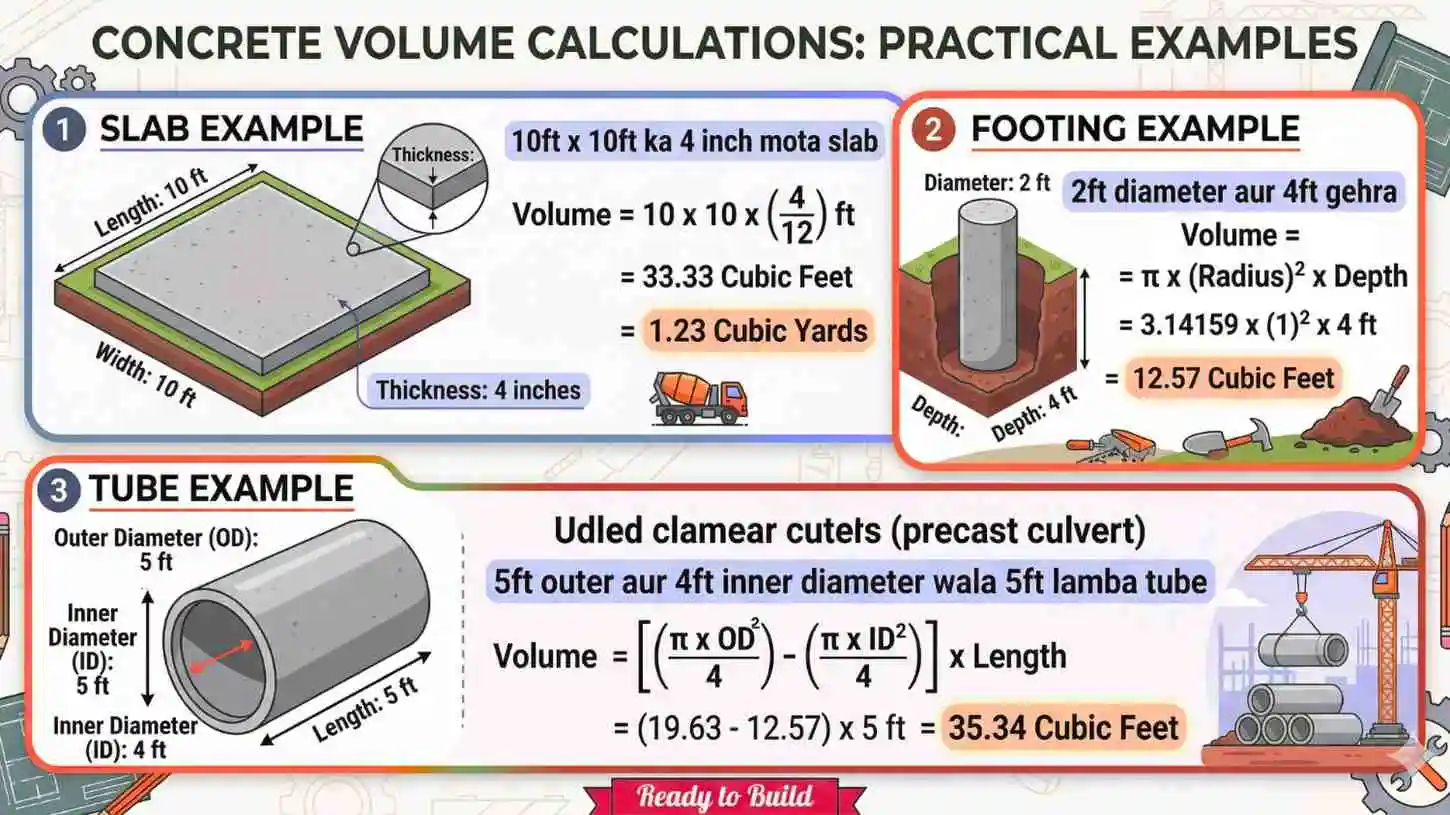
- Slab Example: 10ft x 10ft ka 4 inch mota slab = 1.23 Cubic Yards.
- Footing Example: 2ft diameter aur 4ft gehra hole = 12.57 Cubic Feet.
- Tube Example: 5ft outer aur 4ft inner diameter wala 5ft lamba tube = 35.34 Cubic Feet.
A 10-foot by 10-foot slab with a thickness of 4 inches requires about 1.23 cubic yards of concrete. The volume is calculated by first converting the depth into feet (4 inches equals 0.33 feet), then multiplying the depth by the area to find the volume in cubic feet. The final step is to convert the volume from cubic feet to cubic yards by dividing by 27.
A cylindrical hole that measures 2 feet in diameter and 4 feet in depth will occupy about 12.57 cubic feet of space. In calculating the volume, we take half of the diameter (radius), which is 1 foot, then use the equation V = π × r² × h. Here, the answer will be in cubic feet. If you need to convert it into cubic yards, just divide by 27.
A tube with dimensions of 5 feet in length, 5 feet for its external diameter, and 4 feet for the internal diameter has a volume of 35.34 cubic feet. The formula used here to calculate the volume of a hollow cylinder is that of π × (R² − r²) × length, where R represents the external radius of 2.5 feet, while r represents the internal radius of 2 feet. The volume of the material enclosed between the two radii is determined in this manner.
Decoding Units & Weights
The output shows the volume in cubic feet and the weight based on density. This information is crucial because of how dense the substance used is. As such, the weight will be calculated in units of kilograms (kg) as well as in pounds (lbs). This will enable you to easily estimate and coordinate your resources for this project without having to overburden your transportation or equipment.
How Many Bags Do You Need?
Pre-mix concrete bags are a beneficial choice when it comes to smaller jobs where large amounts of concrete would not be ordered.
- 80lb Bag: This covers approximately 0.60 cubic feet.
- 60lb Bag: This covers approximately 0.45 cubic feet.
By using the above-mentioned coverage figures, our estimator instantly calculates the number of bags needed for your project. This calculation takes all factors into account to round off the number and give you enough material to finish the work.
Why Extra is Better?
However, on the practical side, the ground is usually not perfectly leveled or even in its composition, which means that the real material needs may be different from the planned ones. Occasionally, the depth and texture of the surface will differ, and small measurement errors will lead to more material being used than originally expected. Additionally, some material waste is expected when mixing and applying materials. Therefore, it is always recommended to order an extra 10% of the material to ensure no shortages.
*As opposed to making assumptions or guesses about something, it is better to physically visit the place and take accurate measurements since there can be vast differences between the two. Strictly follow the guidance of the contractor, as his practical knowledge can help overcome problems and ensure efficient use of materials.*
Concrete Calculator for Estimate Concrete, Cement & Materials
If you are planning a construction project in the US, a concrete calculator is an incredibly useful tool. Purchasing the proper quantity of concrete is essential if you intend to construct a patio, driveway, or fence posts. This calculator is an easy and effective way of getting an accurate idea of exactly how much concrete mix is required. You can save money and time by using this calculator. Instead of relying on guesswork and getting a more concrete mix than required, this tool allows you to get an accurate calculation based on specific dimensions. This tool is incredibly beneficial for beginners who are not familiar with construction measurements and formulas.
What is a concrete calculator?
The Concrete Calculator is an online tool that can be used to calculate the volume of concrete needed for different construction projects. It can calculate the volume of concrete needed by just inputting the basic values, such as length, width, and depth of the construction project. It can calculate the volume of the concrete needed in cubic yards, cubic feet, or cubic meters. Using this tool, one can accurately calculate the volume of the materials needed for the construction project and order them accordingly.
Why It Matters
The use of this calculator is vital in ensuring that there is efficiency in project planning. This calculator is important in that it helps in the prevention of insufficient quantities of materials. It is essential to ensure that there is no shortage of concrete in the middle of the project. Therefore, the use of this calculator saves you from purchasing extra quantities of materials, which may incur additional costs. Moreover, it saves the materials that are normally wasted. Also, the use of this calculator saves your precious time; otherwise, the calculations may take a substantial amount of your time.
How a Concrete Calculator Works
Types of Projects You Can Calculate
Benefits of Using a Concrete Calculator in the US
There are various advantages of using this calculator, especially in the United States, for individuals such as homeowners, contractors, and builders, as it relates to the standard measurements used in the United States.
Accurate Material Estimation
The biggest advantage of using this tool is that it enables an accurate estimation of materials. As the unit of measurement, 'cubic yards,' is used in almost all construction projects in the United States, a 'concrete calculator' enables you to calculate the exact amount of materials required for any project, thus avoiding any shortages or excess materials.
Cost Efficiency
This tool also helps you save money on the materials and the delivery costs. Too much purchase of concrete can be costly, but too little purchase can make you incur costs on delivery charges. The calculator helps you purchase the exact amount needed.
Time-Saving Tool
Another important advantage of using this tool is that it saves time. Instead of doing calculations, users of this tool get instant results. The use of this tool speeds up the process of planning and completing projects.
Beginner-Friendly
This calculator is user-friendly. This tool is perfect, especially for those who are beginners and have no technical or construction expertise. There is no need for any special mathematical or professional skills in order to make the most out of this tool. All you need are the basic measurements such as length, width, and depth.
Reduces Waste
The purpose of this tool is to assist in reducing waste material, as it is able to estimate exactly how much material is needed. Instead of relying on guesswork and purchasing more than is needed, this tool allows one to use actual calculations in purchasing the amount of material that is needed. By using this tool, any extra concrete that is ordered is not wasted and is not able to harm the environment. By purchasing only the amount of material that is needed, one is able to save money.
In general, using concrete calculators in the U.S.A. can make the whole construction process much faster and better.
Conclusion
This tool is a must-have for anyone working on construction projects in the US. This tool helps you simplify your calculations and be accurate in your work. Therefore, it is essential to plan better. Whether you are a beginner in construction work or a professional in the field, this tool is vital in ensuring that you get the exact amount of concrete mix every time. By using accurate calculations, you are able to work with confidence, thus saving you time and money while at the same time reducing wastage.