
For any construction work in the US, irrespective of whether it is a driveway, patio, foundation, or sidewalk, it is important that one calculates the exact quantity of concrete needed. Failure to order sufficient concrete will result in delays, while ordering more than the necessary quantity will result in unnecessary wastage and costs. At such times, the concrete calculator yards will be useful. It is important to note that concrete is generally sold by volume in cubic yards; hence, knowing how to calculate the volume of the concrete will be essential.
What is a concrete calculator yards?
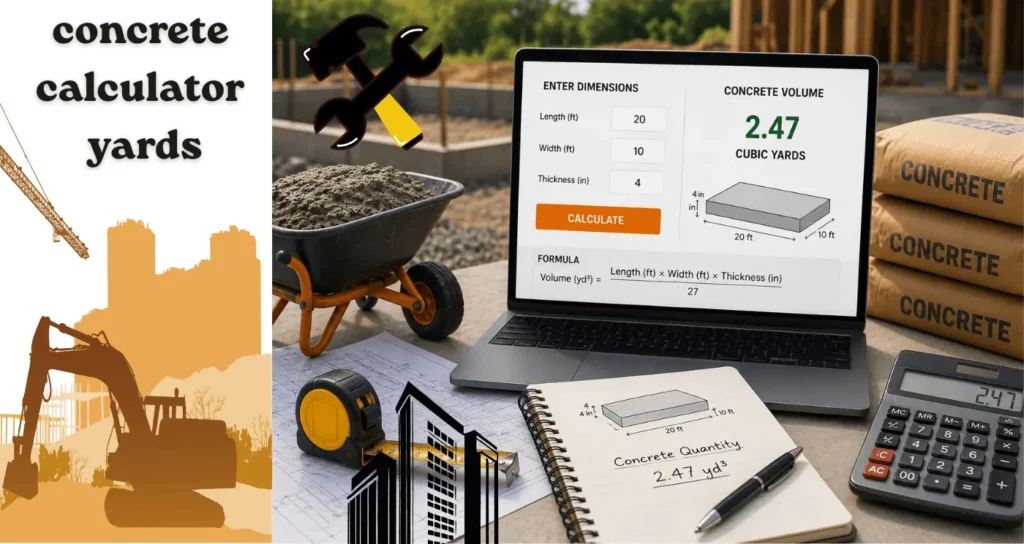
The Concrete Calculator US is one of the most effective calculators that help users determine the amount of concrete required for any work. The calculator uses measurements such as length, width, and depth to calculate the exact volume of concrete. So, the calculation gets easier, and there won’t be too much or too little material.
In the USA, the system of measuring concrete by cubic yards is widely adopted. One of the advantages of this system is that it allows for measuring a great number of materials, which contributes to its popularity. What’s more, cubic yards are useful from the point of view of ordering, since this measurement system allows putting a reasonable price on materials.
Why You Should Use
Use of a cost calculator not only makes your life easier but also becomes indispensable for your planning needs. This will save your money from overspending due to over-purchasing, ensure that you have enough material and hence avoid any delay, improve accuracy by avoiding mistakes in your own calculation, and save your time through a fast and efficient calculation process. If you are either an amateur or a professional, a concrete calculator yards will make your work straightforward and hassle-free.
How to Use an Online Concrete Calculator
Calculating concrete online is easy and will help you estimate how much concrete you need for your project. To do the calculation, just follow these straightforward steps:
1. Measure the Area
Start off by measuring the area that needs concrete with care using the dimensions of its length, breadth, and height. Ensure the use of an accurate tool for measurement and take several readings when dealing with an uneven surface. Precise measurements are critical since slight discrepancies could result in giant variances. Remember to ensure that you use a consistent unit of measurement throughout.
2. Choose the Shape
Users can select the shape using the concrete calculators available online. The shapes range from slabs, columns, footings, walls, or even circles, depending on what is desired. This variation is because there are different formulas for different shapes.
3. Enter the Dimensions
Enter the values that you have discovered into the respective parts of the calculator. Should the dimensions of a rectangular prism be what you have discovered, then your measurements would most probably include three different values, which are length, width, and height.
4. Select the Unit
Change your calculator settings to use cubic yards as the output unit, since that is the unit used in the United States to order concrete. Your calculator will be able to convert units from either feet or inches to cubic yards automatically.
5. Calculate the Volume
Click on calculate, and the answer will be generated for you. The calculator calculates the concrete volume that you require based on the data you provide.
6. Add Extra for Safety
To prevent oneself from going into a deficit, provide yourself with an additional 5–10 percent above what you have estimated. This will cover anything that may occur due to spillage or discrepancies caused by the land and the formwork.
7. Review and Order
Finally, go through all the values again and check the result obtained. When sure that everything is correct, use the final volume to order the concrete. Good planning is crucial as it helps prevent any inconveniences throughout the entire project.
Tips for Accurate Concrete Estimation
Measurements should be taken correctly because any small mistake can result in significant changes in the total volume of concrete required. Use the same units for measurements, and make sure they are in feet to convert to cubic yards. The depth measurement is usually a point Caution should be exercised in case of error. It will be prudent to overestimate while doing the computations to allow for any possible shortage of concrete during the construction process.
Common Mistakes to Avoid
One possible source of error is not considering the proper conversion of units, because it is possible that one might mix units such as inches and feet, which might result in incorrect values when computing the amount of concrete needed. Not considering surface differences is also a possible reason, as an uneven surface may require more concrete than initially planned. It may also be a problem to order precisely what was computed, so it would be best to buy extra concrete just in case there is a shortage along the way.
DIY vs Professional Estimation
For small projects and simpler shapes, DIY estimates are advised, owing to the fact that, with primitive calculations and formulas, one can determine the quantity of concrete required. Nevertheless, in the case of large construction projects with complex designs, it is better to hire professionals for the estimate process because it requires very accurate results. This is because professionals use advanced tools and take into account various factors, such as weight-bearing capacity.
Advanced Considerations
When talking about an inclined surface, it is essential to take into account how the average depth is computed. To do that, the highest number and the smallest are added and then divided by two. That would make it simpler to come up with a more accurate figure concerning the quantity of concrete required. If the area is irregular, it’s best to divide it into smaller parts and calculate the volume of each before adding them all.
Regarding the pricing in America, the cost of concrete per cubic yard ranges from $100 to $150, depending on the location. The simplest formula to use is multiplying the cubic yards by the yard’s price.
Conclusion
The first thing that needs to be mentioned here is the fact that you need to have a concrete calculator yards that calculates cubic yards in either one of the two cases. One such case involves you being someone who knows nothing about how to do calculations involving cubic yards of concrete. You can be an expert at these calculations, but you should still use a concrete calculator. This is because, through the use of the calculator, you can easily manage your expenses while avoiding any miscalculations.
FAQ’s
Q1. What is the reason for selling concrete in cubic yards in the US?
Concrete is sold in cubic yards in the USA, as it makes ordering easier and is consistent with the standards adopted by manufacturers.
Q2. What do concrete calculator yards mean in the United States?
A concrete calculator refers to an application that enables one to calculate the amount of concrete required for a task in terms of cubic yards, which are the commonly used units in America.
Q3. Do I need a professional for concrete estimation?
For smaller assignments, there is no requirement for any particular skill set. Larger assignments require the presence of an expert.
Q4. How many bags of concrete make one cubic yard?
To make one cubic yard of concrete, you will need 45 bags, each weighing 80 pounds. The amount may change depending on the mix.
Q5. What is the cost of concrete per cubic yard in the USA?
Concrete normally costs between $100 and $150 per cubic yard.